Everybody loves a good mystery and New England has more than its share. One of the most implausible but intriguing legends is what has become known as the Westford Knight. The mystery surrounds a carving on a rock ledge that some believe is evidence that a Scottish Earl, Henry St. Clair, led an expedition to the New World almost 100 years before Columbus.
The first published account of the carved ledge in Westford, Massachusetts was in 1873 in the Gazetteer of Massachusetts and the description read, “There upon its face a rude figure, supposed to have been cut by some Indian artist.” The carving was well known by locals and was thought to be Native American pictographs called an “Indian smoking a pipe.”
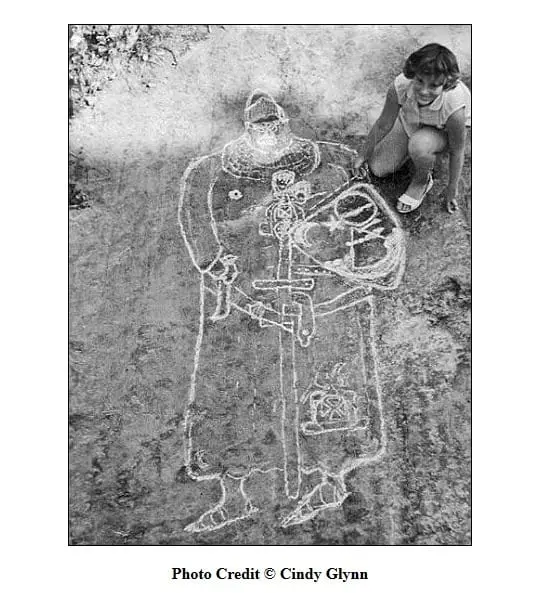
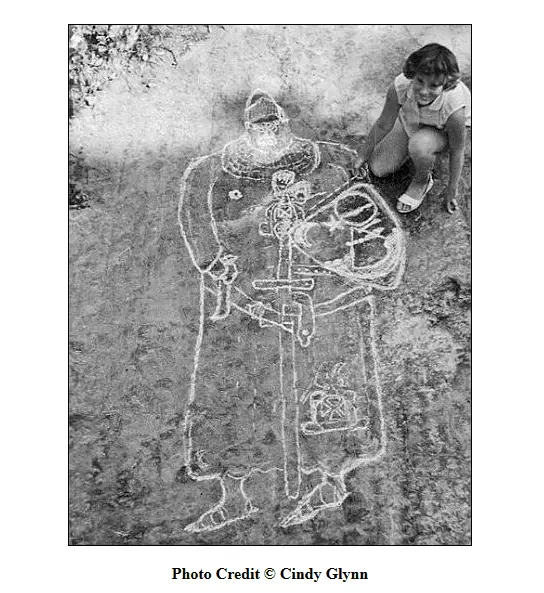 The carving was subsequently interpreted not as a human figure but as a broken Norse sword by William Goodwin in his book on the America’s Stonehenge site. In 1954 Frank Glynn, president of the Archaeological Society of Connecticut identified the carving as a 14th-century Scottish knight in full armor. Glynn had been searching for the carving for two years when he and his daughter Cindy were guided to the carving by researcher and photographer Malcolm Pearson.
The Glynns’ examined the faint punch marks and little by little removed the dirt and grass which hid the rest of the figure. It was Glynn’s daughter who first pointed out the weathered outline of a knight in full armor with a sword and shield. Glynn initially thought the carving might be of Viking origin.
Glynn photographed and took rubbings of the carving and sent them to his correspondent Dr. Thomas C. Lethbridge in England, a well-known but somewhat controversial archaeologist. Lethbridge immediately recognized the carving to resemble funerary monuments from the middle ages in western Scotland. Lethbridge proposed to Glynn that the sword was not of Viking origin but was “a hand-and-a-half wheel pommel sword” common in 14th-century North Britain.
To identify the devices on the shield he referred the matter to an expert in heraldry. The expert suggested that the devices resembled the coat of arms for the Clan Gunn of Scotland. It has been suggested that the knight is Sir James Gunn a Knight Templar who reportedly traveled with Prince Henry Sinclair, Earl of the Orkney Lord of Roslin.
Prince Henry, the story goes, became interested in finding the New World when a fisherman told a remarkable story of having been driven far west by storms until he reached a temperate land peopled by strange natives. Greenland already had settlements and the fisherman’s stories suggested that this new land lay somewhere beyond.
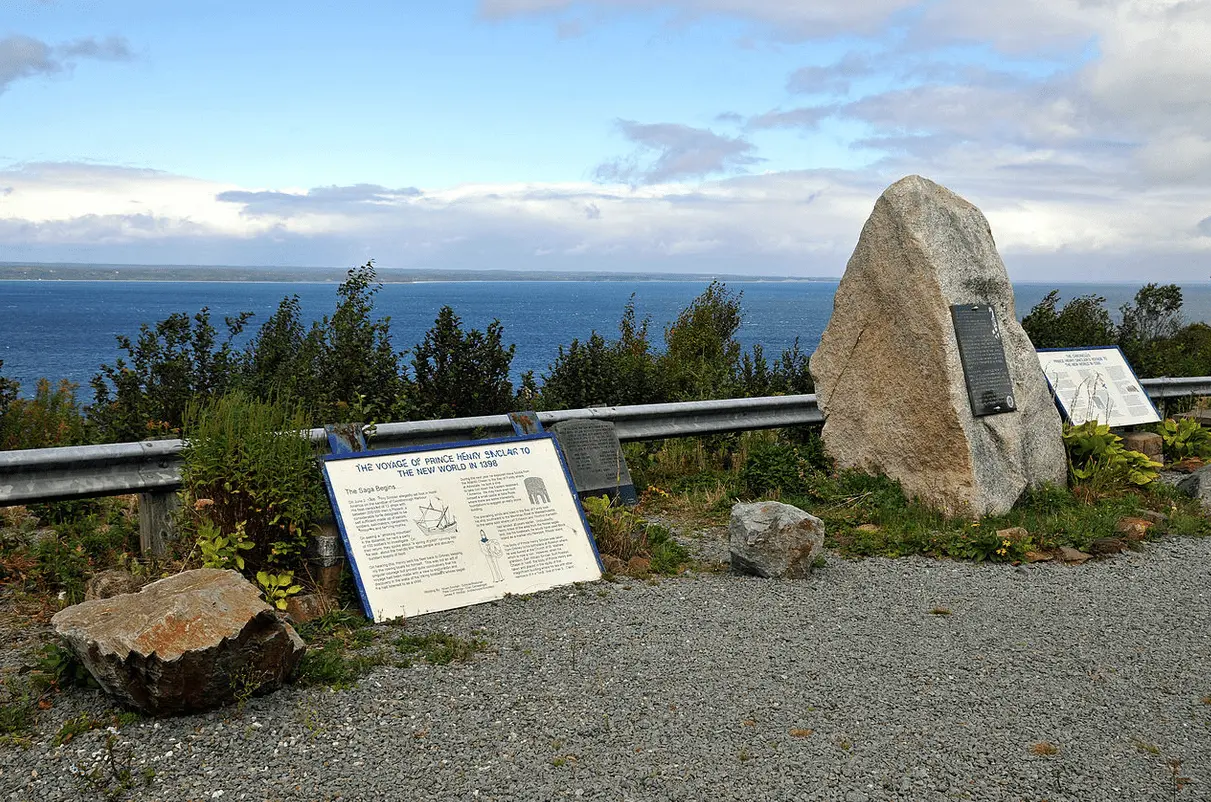 Prince Henry was determined to find out and sometime in the late 1390s led an expedition west accompanied by two Venetian brothers, Nicola & Antonio Zeno, who were experienced navigators. Sailing west past Greenland they landed in Cape Breton in Nova Scotia where Prince Henry established a settlement at Louisbourg. This settlement predated the arrival of the French in 1713 that settled the town and built the famous fortress of Louisbourg.
Continuing to explore, Prince Henry left his settlement and proceeded down the coast to Massachusetts. He headed inland sailing up the Merrimac River to where Gunn could have died in or near Westford and Prince Henry ordered a carving as a memorial to him. The carving would have been done by the ship’s armorer using one of his punches to peck out the figure. Part of the image was supplied by the straight scourge marks left by a glacier but a set of parallel punch marks, still clearly seen today, created the hilt of the sword.
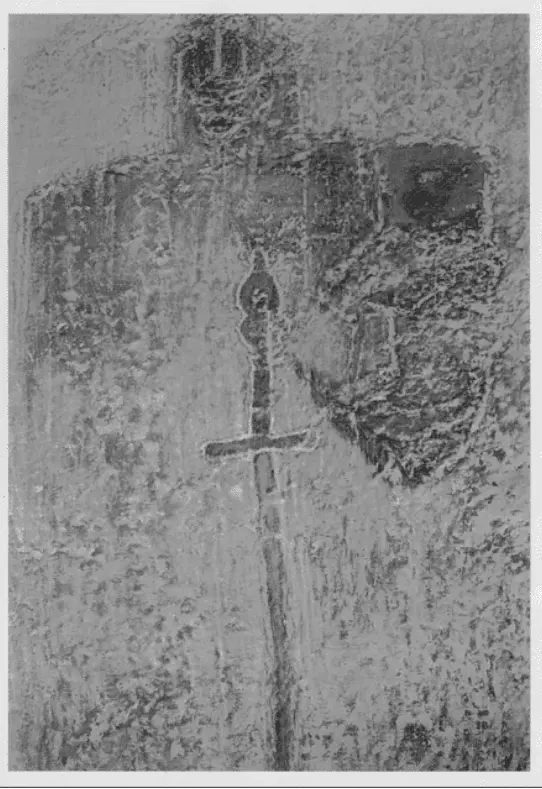 Over the years erosion and weathering of the rock have severely damaged the image since earlier investigations. In his book, “The Sword and the Grail,” Andrew Sinclair writes about his experience at the site. With him was Marianna Lines well known for her method of rubbing stones with vegetable and floral juices to reveal details on eroded surfaces.
Sinclair writes, “The rubbing showed a helmeted knight wearing the habit of the military orders with his shield and his sword engraved on the rock in the formal style of the late thirteenth and early fourteenth century. The outline of the sword has remained strong. It points due north and suggests a ritual burial. It is shown as broken twice below the hilt. The custom of the time was to break the sword of a knight of great courage and distinction and to bury it with his body. The effigy of the Westford Knight is some seven feet tall and depicts a powerful man.”
Sinclair goes on to propose that this inland exploration up the Merrimac River to Westbrook happened as Prince Henry was on his way to Newport, Rhode Island. There he established a second settlement and built the enigmatic Newport Tower as a Templar church, lighthouse, and watchtower. The Templars were a Catholic military order that had been disbanded ninety years before Prince Henry’s voyage.
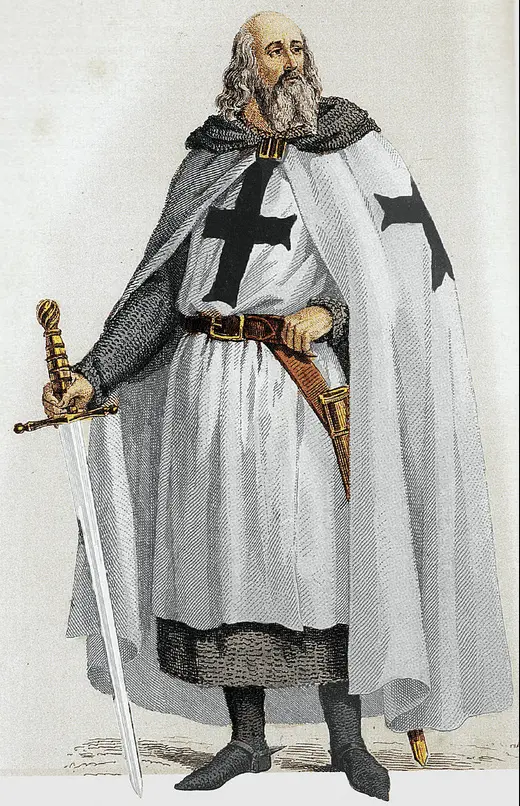 However many Templars fled to Scotland after they were outlawed and the theory goes they took their treasure with them. This treasure was acquired in the first crusade with the sacking of the Solomon’s Temple in Jerusalem and included The Holy Grail.
The publication of Dan Brown’s highly successful novel, The Da Vinci Code, in 2003 renewed interest in the obscure Westford carving and its possible connection to the Sinclair clan. The 14th-century Rosslyn Chapel in Scotland built by William Sinclair, Prince Henry’s grandson, became attached to the Grail legend. A number of conspiracy books have identified the Rosslyn Chapel as a secret hiding place of the Grail. Some also suggest that the Templar treasure could have been carried to the New World on one of Prince Henry’s ships.
To add even more to the mystery of the Westford Knight, a 250-pound carved stone was found in 1930 nearby when a road was being widened. Groton Road is about two miles from the base of the hill where the Westford Knight is found. The Boat Stone, as it’s now named, has a carving of a single masted ship on it, similar to the ships that Prince Henry would have sailed. There is also the number 184 and an arrow.
In 2007, Forensic Geologist Scott Wolter studied the stone. It was his opinion that the weathering patterns in the carving indicated that the carving was not modern and that the weathering was consistent with that of a 600-year-old artifact. Wolter further determined the carving was made using a “pecking” or “punch-hole” technique with a metal tool, similar to the technique used to carve the Westford Knight carving.
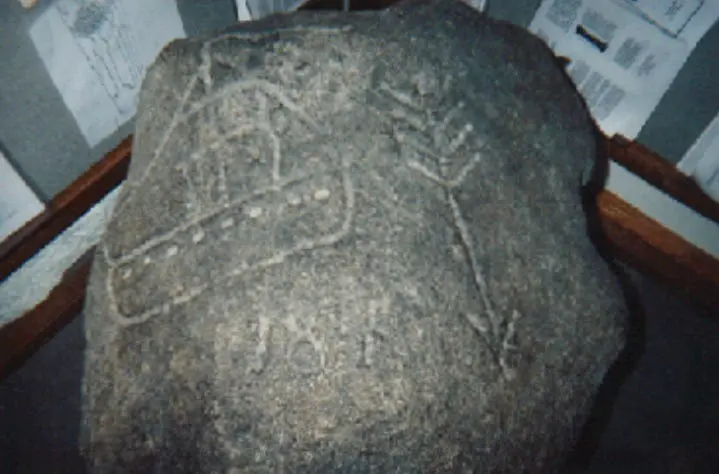 Approximately 184 paces from the Boat Stone’s original 1920s location there are the remains of a 40×32 foot rectangular stone foundation. Some researchers believe it may be the vestiges of the winter encampment site used by Sinclair during his 1398-1399 expedition. The Boat Stone is currently on loan from the Westford Historical Society to the J.V. Fletcher Library, where it is displayed on the ground floor.
Prince Henry returned to Orkney in 1399 telling stories of the land he had found and making plans to return on a larger expedition. It was not to be, he died fighting English raiders in Orkney in 1400. The documentary evidence for Prince Henry’s voyage remains in doubt as it was largely based on letters written later by the Zeno brothers and much of their account has inaccuracies.
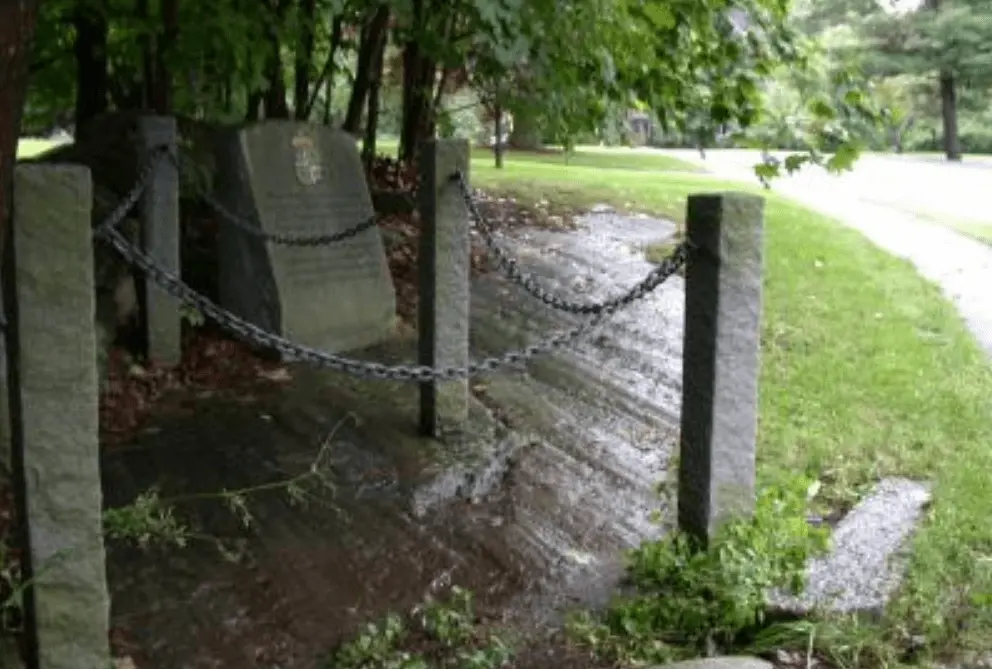 Today the Westford Knight is largely dismissed as pseudo-archaeology. Over the last 100 years the rock ledge has become so weathered that the enigmatic figure is now almost impossible to discern except by ardent believers.
A stone marker nearby reads: “Prince Henry, First Sinclair of Orkney, Born in Scotland, made a voyage of discovery to North America in 1398. After wintering in Nova Scotia, he sailed to Massachusetts and on an inland expedition in 1399 to Prospect Hill to view the surrounding countryside, one of the party died. The punch-hole armorial effigy, which adorns this ledge, is a memorial to this knight.”
Whether the Westford Knight is a natural phenomenon, a Native American pictograph, or a fourteenth century memorial to a Scottish Knight Templar is lost in the mists of history but it still makes a great story. The Westford Historical Society website has more information and directions to the Westford Knight.