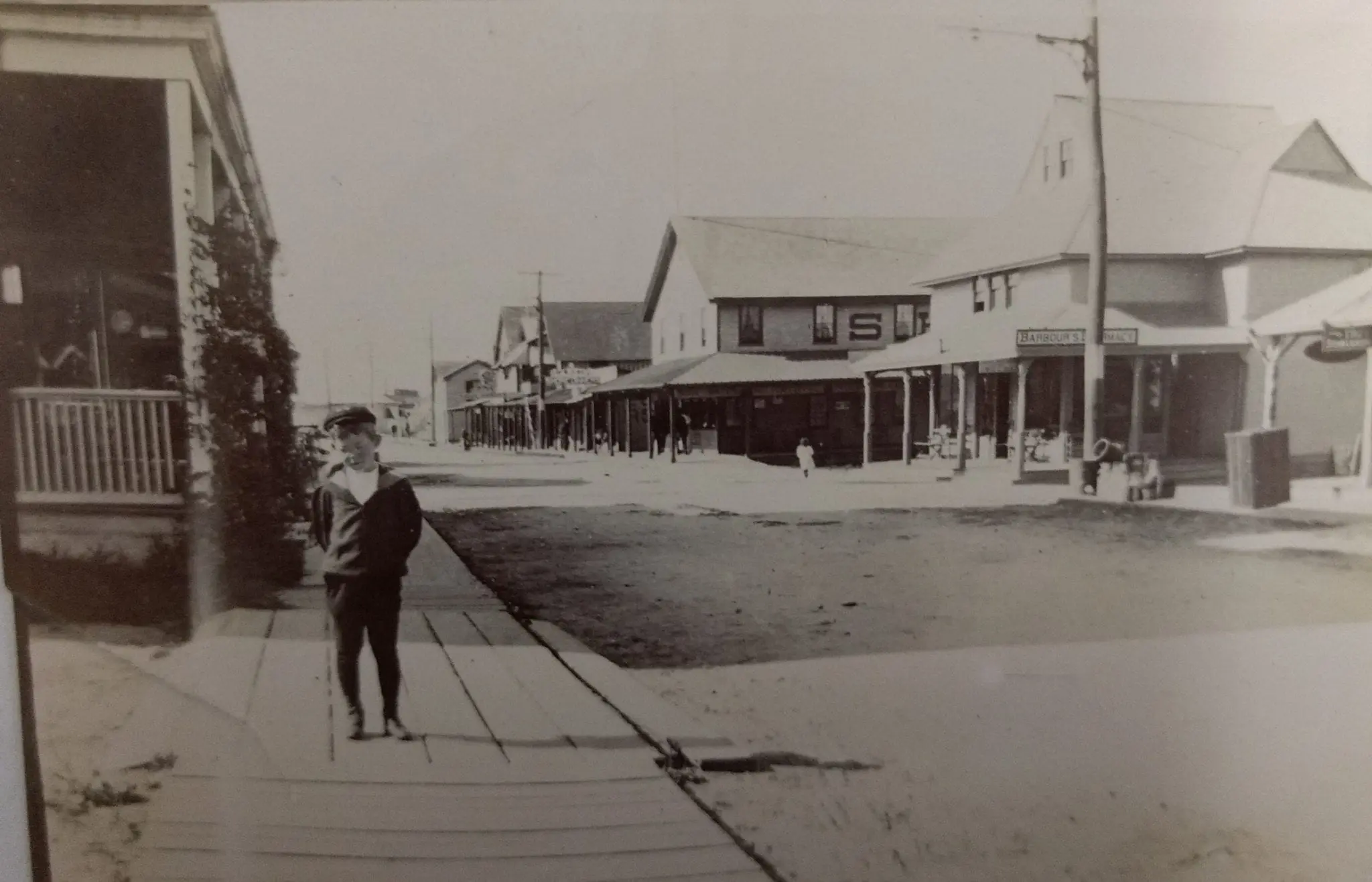
For more than 180 years, Watch Hill has served as a (relatively) quiet, unspoiled summer resort. While Watch Hill’s status as a premier summer locale can be traced back to 1883, when a Cincinnati syndicate purchased a 160-acre land tract and divided it into numerous home lots, the following decade, just before the turn of the century, was a true boom period.[1]
As is still the case today, the population of Watch Hill was largely seasonal during the 1890’s. According to one account from 1893: “the summer population of the point is from 1500 to 2000” which they contrast to the population of 36 winter residents, only fishermen.[2] After the 1883 land sale, the seasonal population seemed to increase annually. The growing number of summer residents resulted in a building surge through the village, as homes began to spring up seemingly overnight, with dozens built throughout the decade.
 Those who did not have their own home or chose not to rent a house could stay at one of the hotels known collectively as the “eight great houses:” the Columbia House (built in 1890, destroyed by a fire in 1916), Plimpton House (built in 1865, demolished in 1906), Narragansett House (1844, now the Watch Hill Inn), Bay View House (built in 1870), Atlantic House (built in 1855-1856, destroyed by a fire in 1916), Larkin House (built in 1868, demolished in 1906), Watch Hill House (built in 1835, destroyed by a fire in 1916), and the Ocean House (built in 1868, demolished in 2005 and reopened in 2010).[3]
During the 1890’s, Watch Hill was exceptionally fashionable among the wealthy from cities across the eastern United States, especially New York City. Because of the 1883 land deal with a syndicate from Cincinnati, the entire north end of Watch Hill was peopled by Cincinnatians.[4] Another notable homeowner in Watch Hill during the earliest period was former Rhode Island Governor Henry Howard.[5]
In addition to the stately, picturesque homes, Watch Hill also boasted numerous other sites worthy of attention including the Shore Dinner House, which was known for its daily clam bakes, The Misquamicut Golf Club, and the Watch Hill Billiard Room and Bowling Alley, which was for the exclusive use of hotel guests and cottagers.[6] Residents and visitors alike could also spend time at one of Watch Hill’s beaches, known as the surf beach and the bathing beach.[7]
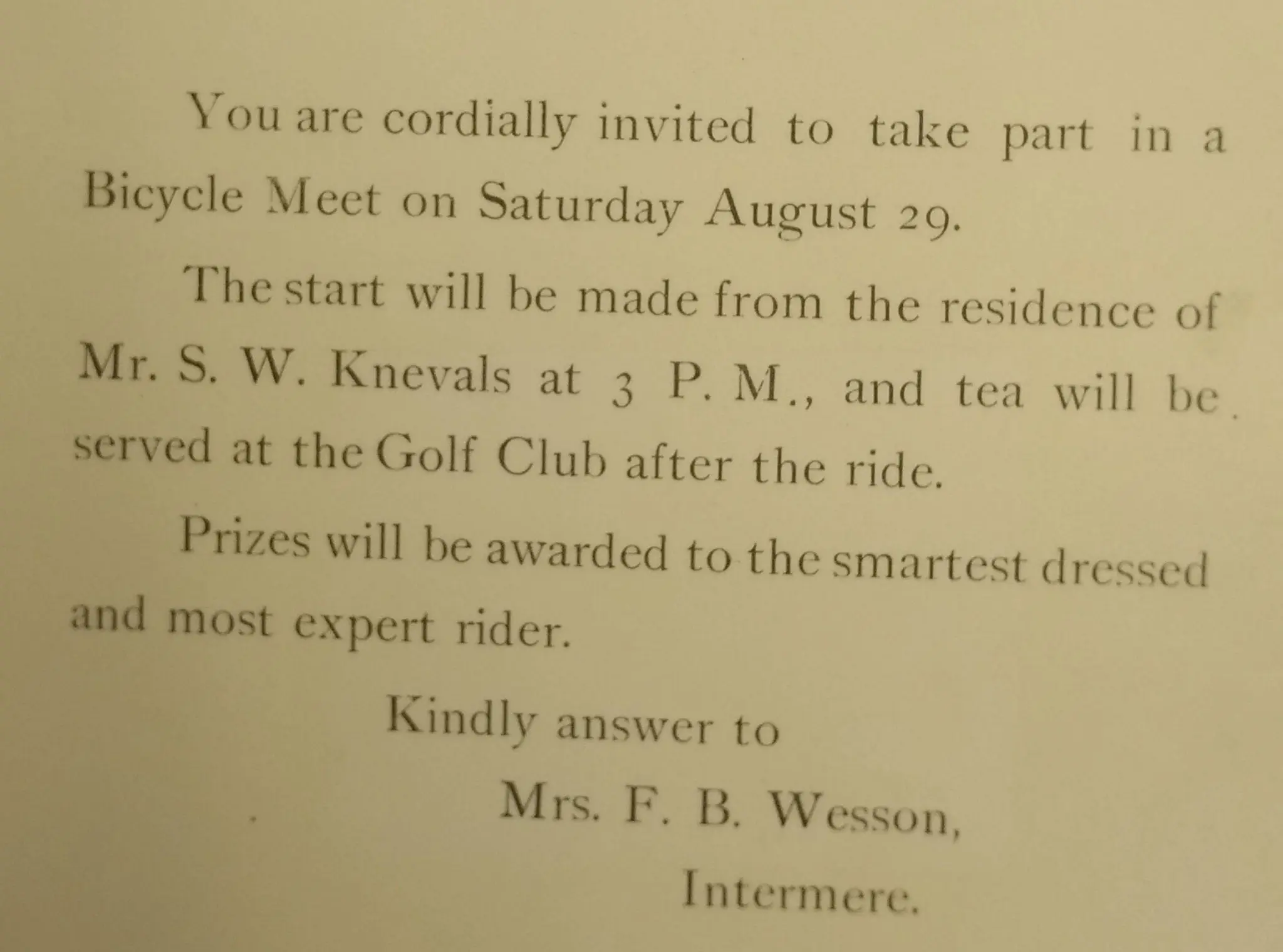 While certainly typical for the upper classes of the 1890’s, the outfits sported by the men, women, and children of Watch Hill would be considered highly unique compared to modern fashion. As the 1893 account noted: “the young girls dress with perfect simplicity in dainty gingham and outing flannels.”[8] As for the ladies: “Diamonds and other precious stones decked the hands of the fair dames.”[9] Men were also known to sport bright red golf jackets to formal occasions.[10] Numerous events even awarded prizes for the “smartest dressed.”[11]
Despite being removed from downtown Westerly and other hubs including Norwich, New London, and Providence, there was no shortage of transportation options for visitors. For those coming from locations further away, there were steamships including the Martha which sailed to and from Mystic on Mondays and Fridays, the Block Island which made trips to and from its namesake island, the Watch Hill, which went to and from Stonington, where a connecting ship to New York could be caught, and the Ella which departed from Norwich.[12] Trains could also be taken from as far away as Boston and New York as part of the New York, New Haven, and Hartford Railroad.[13]
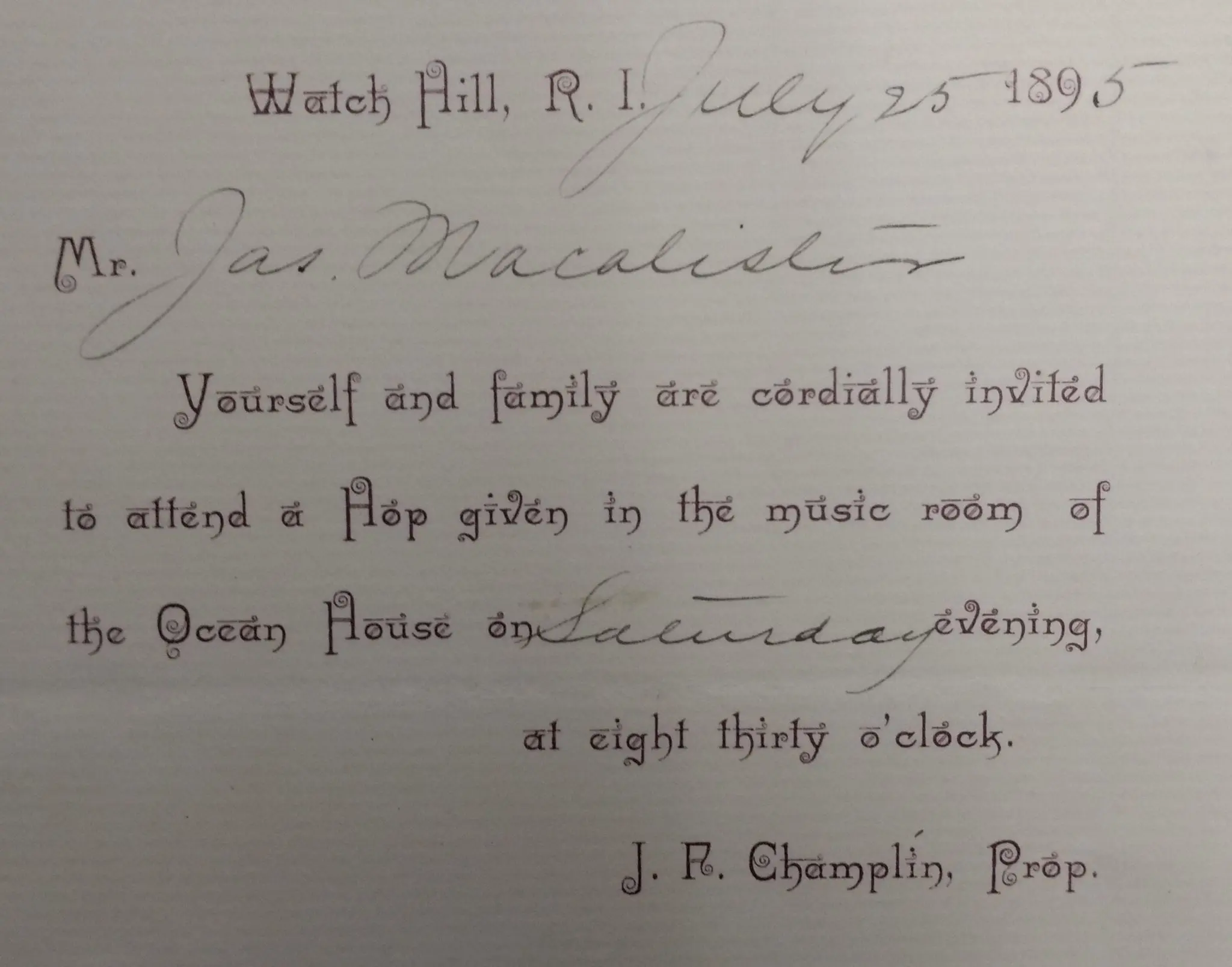
Once guests arrived in Watch Hill, they could participate in numerous activities for all ages. Dances, often referred to as ‘full dress hops,’ were popular. On Thursday, July 25, 1895, for example, a hop was hosted in the music room of the Ocean House.[14] Hops were also held at the beginning of the summer season at many of the local hotels, including the Ocean House’s Red Golf Coat Hop.[15]
To celebrate the opening of their newest dining hall, the Ocean House hosted “a grand ball” which was described as “the social event of the season.”[16] For this gathering, invitations were sent to cottagers and guests at the hotel. Upon arrival, attendees were treated to a well-decorated room dressed with pink bunting and potted plants and music which was provided by the Langstaff Orchestra of Providence.[17] According to one account of the event, it was not late into the evening before “the floor was very quickly filled with the graceful figure of gay dancers.”[18] Concerts were also held annually by the Larkin House Minstrel Company which provided music, comedy sketches, and a cake walk.[19]
 Sports were also a popular pastime for guests and residents alike. Golf, in particular, was widespread throughout the village. Some celebrated the 4th of July, 1895 by attending the opening of the Misquamicut Golf Club, which often hosted mixed foursome tournaments followed by tea.[20] During one summer, it was also said that there were enough tennis players in Watch Hill to host a tournament.[21] On several occasions, there were published accounts of baseball games played between the guests of the Ocean House and the Watch Hill House, showcasing the game’s growing popularity.[22]
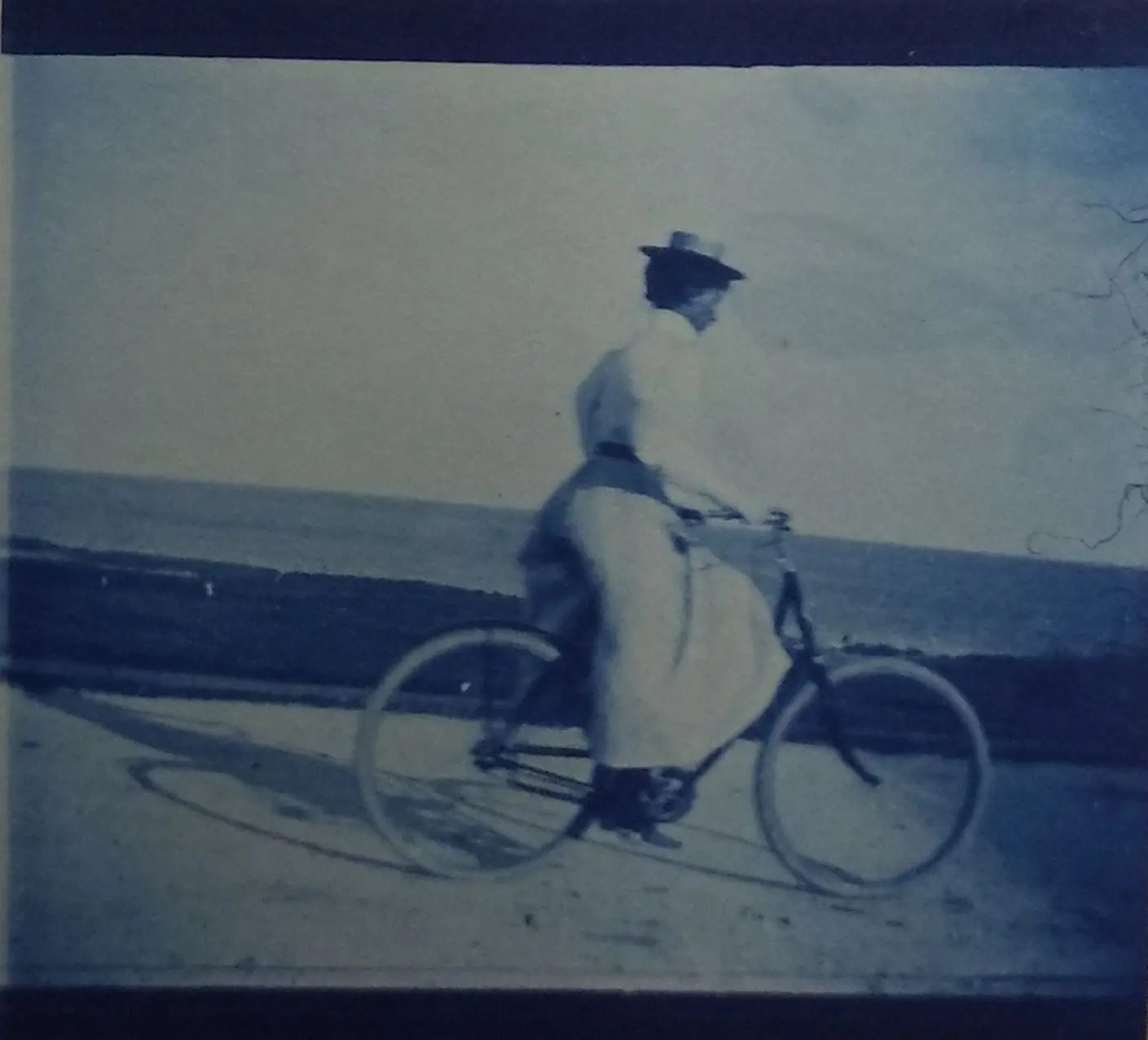
However, the most popular activity, without a doubt, was bicycling, which saw its first heyday in the 1890’s. According to one description, a Watch Hill bicycle fete was “a scene of unusual brilliancy and animation.”[23] The fete was attended by “hosts of people in bright summer costumes, with a number of brilliant red golf coats scattered throughout the crowd.”[24]
 This particular fete began with a parade beginning shortly after three in the afternoon, which featured bicycles which were “brightly and tastefully decorated.”[25] The event also featured a ‘slow race,’ as well as a trick riding exhibition held by many younger riders, and an egg-and-spoon race.[26] When cycling, the women of Watch Hill were said to have worn outfits which were “particularly tasteful.” One article even went as far as to state “it is gratifying to note in this connection that the New York style of ladies’ bicycling habit has few or no admirers here.” This was almost certainly referring to the practice of women wearing skirts to ride bicycles in New York.[27]
The 1890’s, the first full decade in which Watch Hill was viewed as a true resort destination, was a decade of both progress and tradition. Those lucky enough to live in Watch Hill or even to have visited would have seen a booming village with beautiful homes, activities to keep them busy for weeks on end, and above all else, family and friends to spend the season with each and every year.
[su_accordion class=””] [su_spoiler title=”Footnotes” open=”no” style=”default” icon=”plus” anchor=”” class=””]
[1] Driscoll, Robin, “Watch Hill in the Gay Nineties” Tidings, July 1983.
[2] Driscoll, Robin, “Watch Hill in the Gay Nineties” Tidings, July 1983.
[3] National Register of Historic Places Inventory Nomination Form, Watch Hill Historic District, 1978.
[4] Driscoll, Robin, “Watch Hill in the Gay Nineties” Tidings, July 1983.
[5] Driscoll, Robin, “Watch Hill in the Gay Nineties” Tidings, July 1983.
[6] “Advertisement, Watch Hill Life, 12 July 1894.
[7] Driscoll, Robin, “Watch Hill in the Gay Nineties” Tidings, July 1983.
[8] Driscoll, Robin, “Watch Hill in the Gay Nineties” Tidings, July 1983.
[9] Driscoll, Robin, “Watch Hill in the Gay Nineties” Tidings, July 1983.
[10] “The Bicycle Fete” Watch Hill Life, date unknown, in the “Cragie Brae Guestbook” courtesy of the Westerly Historical Society.
[11] Invitation for a Bicycle Meet, Saturday, August 29, 1896, in the “Cragie Brae Guestbook” courtesy of the Westerly Historical Society.
[12] “The ‘Martha’ of Westerly” Watch Hill Life, and “The Steamer Block Island,” Watch Hill Life, both from the “Cragie Brae Guestbook” courtesy of the Westerly Historical Society, and Stonington and Watch Hill Ferry Advertisement, Watch Hill Life, 12 July 1894.
[13] N.Y.N.H & H.R.R. Advertisement, Watch Hill Life, 12 July 1894.
[14] Invitation for a Hop, Saturday, July 25, 1895, in the “Cragie Brae Guestbook” courtesy of the Westerly Historical Society.
[15] Invitation for the Red Golf Coat Hop, Saturday, July 22, 1899, in the “Cragie Brae Guestbook” courtesy of the Westerly Historical Society.
[16] “First Annual Ball” Watch Hill Life in the “Cragie Brae Guestbook” courtesy of the Westerly Historical Society.
[17] “First Annual Ball” Watch Hill Life in the “Cragie Brae Guestbook” courtesy of the Westerly Historical Society.
[18]“First Annual Ball” Watch Hill Life in the “Cragie Brae Guestbook” courtesy of the Westerly Historical Society.
[19] Account of the Larkin House Minstrel Company Concert, Watch Hill Life in the “Cragie Brae Guestbook” courtesy of the Westerly Historical Society.
[20] Invitation for the Opening of the Misquamicut Golf Club, Thursday, July 4, 1895, in the “Cragie Brae Guestbook” courtesy of the Westerly Historical Society.
[21] “Tennis at Watch Hill” Watch Hill Life, 23 July 1894.
[22] “A Challenge Game” Watch Hill Life, 15 July 1896, and “Monday’s Ball Game” Watch Hill Life, 22 July 1896.
[23] “The Bicycle Fete” Watch Hill Life, date unknown, in the “Cragie Brae Guestbook” courtesy of the Westerly Historical Society.
[24] “The Bicycle Fete” Watch Hill Life, date unknown, in the “Cragie Brae Guestbook” courtesy of the Westerly Historical Society.
[25] “The Bicycle Fete” Watch Hill Life, date unknown, in the “Cragie Brae Guestbook” courtesy of the Westerly Historical Society.
[26] “The Bicycle Fete” Watch Hill Life, date unknown, in the “Cragie Brae Guestbook” courtesy of the Westerly Historical Society.
[27] Account from Watch Hill Life, in the “Cragie Brae Guestbook” courtesy of the Westerly Historical Society, and Cripps, Aaron, “Women on the Move: Cycling and the Rational Dress Movement” Cycling History, https://cyclehistory.wordpress.com/2015/01/30/women-on-the-move-cycling-and-the-rational-dress-movement/.
[/su_spoiler] [/su_accordion]